


A conference talk in San Diego made the rounds last month. The claim got compressed into a single alarming line: healthy eating may cause lung cancer in young non-smokers.
That isn’t what the study said. But it’s what the headlines said.
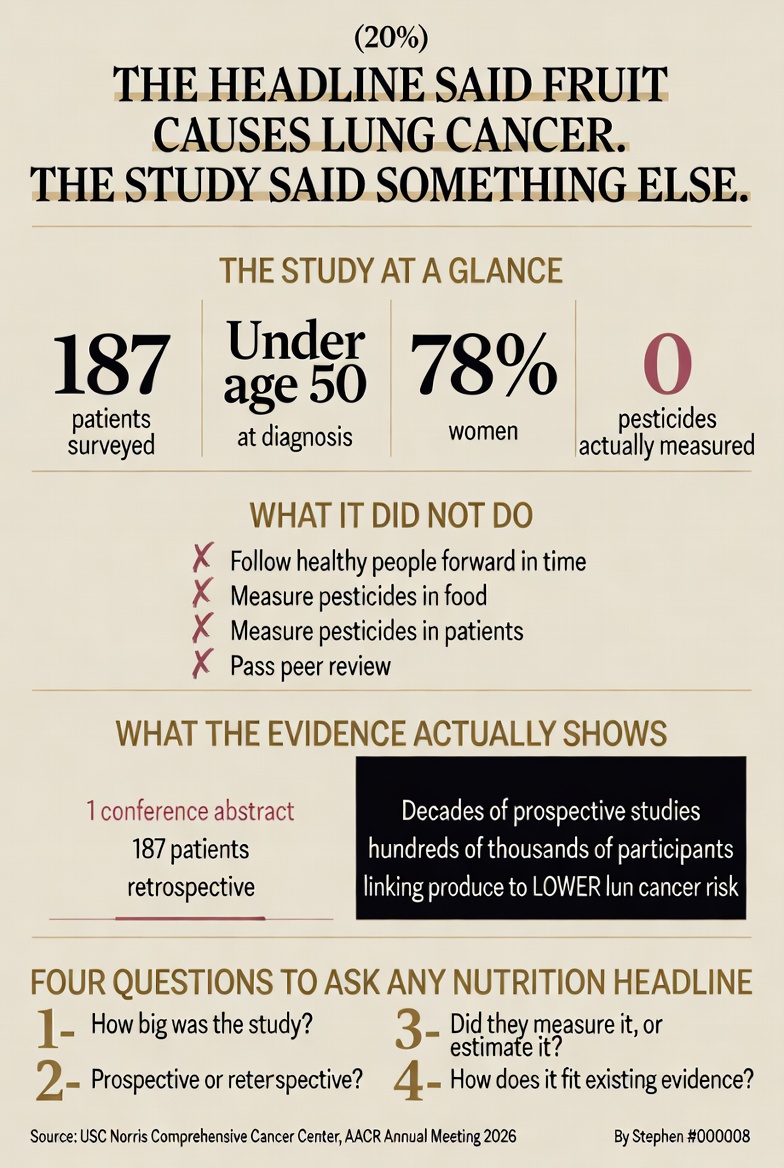
The research came from the USC Norris Comprehensive Cancer Center and was presented at the American Association for Cancer Research annual meeting in April 2026.[^1] Lead investigator Dr. Jorge Nieva and his team surveyed 187 patients diagnosed with lung cancer before age 50.[^2] Most had never smoked. Seventy-eight percent were women.[^3] When asked about their diets, a striking number reported eating more fruits, vegetables, and whole grains than the average American — scoring 65 on the Healthy Eating Index versus a national average of 57.[^4]
That’s the finding. A correlation in a small group of patients who already had cancer.
Nieva himself was careful. He didn’t say produce causes cancer. He pointed to a different suspect: pesticide residue.[^5] His team didn’t measure pesticides in anyone’s blood or urine. They estimated probable exposure using published averages for food categories.[^6] The next step, Nieva said, is to actually measure pesticide levels in patient samples.[^7]
That’s the entire study. One hundred eighty-seven people. Retrospective. Indirect exposure estimates. Unpublished. Not yet peer-reviewed.[^8]
Then came the headlines.
What the study can and cannot tell you
A retrospective survey of cancer patients cannot tell you what caused their cancer. It can only tell you what those patients reported eating. To establish causation, you need prospective studies — researchers following healthy people forward in time, recording what they eat, and waiting to see who develops disease.
Those studies exist. They cut the other direction. Meta-analyses pooling data from hundreds of thousands of participants consistently find that higher fruit and vegetable intake is associated with lower lung cancer risk, particularly in smokers.[^9] These are the studies that inform federal dietary guidelines. They are imperfect. They are also vastly more informative than a 187-person conference abstract.
Professor Justin Stebbing of Anglia Ruskin University, writing in The Conversation, made the point cleanly: small studies like this one are designed to raise questions, not rewrite dietary advice.[^10]
The pesticide question deserves a real answer
This is where the story gets more interesting and less cartoonish.
Pesticides are not benign. Farm workers with regular high-dose exposure show elevated rates of certain cancers, including some lung cancers.[^11] People who eat a lot of conventional produce do carry higher levels of pesticide breakdown products in their urine.[^12] These are documented facts.
What is not documented is a causal link between eating washed supermarket produce at normal dietary levels and developing lung cancer. The Nieva study did not establish that link. It hypothesized it.
There is a serious, separate conversation about cumulative chemical exposure, vulnerable populations, and the regulatory gap between single-pesticide safety thresholds and real-world cocktails of agricultural chemicals. That conversation is worth having. It is an argument for better farming and tighter regulation. It is not an argument for skipping the produce aisle.
How to read a nutrition headline
Four questions, every time:
How big was the study? Was it prospective or retrospective? Did the researchers measure what they’re claiming, or estimate it? How does the finding sit against the existing body of evidence?
Run the Nieva study through that filter. It was small. It was retrospective. It estimated exposure rather than measuring it. And its implication runs against decades of contrary data.
That doesn’t make the work worthless. It makes it a starting point. Nieva’s team has said the next phase will involve direct biomonitoring — testing actual blood and urine samples for specific pesticide compounds.[^13] That’s the study worth waiting for.
Until then, the practical guidance hasn’t changed. Wash your produce under running water. Vary what you eat. If your budget allows and you want to, buy organic versions of foods on the EPA’s higher-residue lists. These are reasonable adjustments at the margins.
What they are not is a reason to fear the apple.
Footnotes
[^1]: USC Norris Comprehensive Cancer Center / Keck Medicine of USC, “Eating fruits, vegetables and whole grains may increase chance of early onset lung cancer,” April 2026. Presented at the AACR Annual Meeting 2026, San Diego. https://news.keckmedicine.org/eating-fruits-vegetables-and-whole-grains-may-increase-chance-of-early-onset-lung-cancer/
[^2]: Epidemiology of Young Lung Cancer Project, abstract 5039/12, “Dietary patterns in young lung cancer: mutation-specific environmental associations,” AACR Annual Meeting 2026.
[^3]: Newsweek, “Fruits and Vegetables May Increase Your Cancer Risk, New Research Shows,” April 2026. https://www.newsweek.com/fruits-and-vegetables-may-increase-your-cancer-risk-new-research-shows-11855518
[^4]: Easy Health Options, citing the Healthy Eating Index data from the USC Norris study. https://easyhealthoptions.com/healthy-eating-lung-cancer-risk-pesticides/
[^5]: Statement from Dr. Jorge Nieva, medical oncologist and lead investigator, Keck Medicine of USC press release, April 2026.
[^6]: Healthline, “Lung Cancer Risk in Young Nonsmokers Linked to Fruits, Vegetables,” reporting on study methodology. https://www.healthline.com/health-news/pesticides-healthy-foods-lung-cancer-risk-people-under-50
[^7]: ScienceDaily, “Eating more fruits and vegetables tied to unexpected lung cancer risk,” April 2026. https://www.sciencedaily.com/releases/2026/04/260417224454.htm
[^8]: Healthline confirmed the research had not yet been published in a peer-reviewed journal at the time of presentation.
[^9]: Justin Stebbing, “Eating fruit is linked to lung cancer? Here’s what you need to know about that new study,” The Conversation, April 2026. https://theconversation.com/eating-fruit-is-linked-to-lung-cancer-heres-what-you-need-to-know-about-that-new-study-281003
[^10]: Stebbing, The Conversation, ibid.
[^11]: Stebbing citing established occupational health literature on agricultural worker cancer rates.
[^12]: Stebbing, ibid., on urinary pesticide metabolites in higher produce consumers.
[^13]: Nieva, quoted via Keck Medicine of USC and Fox News reporting. https://www.foxnews.com/health/healthy-diets-spark-lung-cancer-risk-non-smokers-pesticides-loom